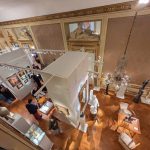

Passerelle – Study day of the Centre for Studies and Resources on Asian Artists in France (CERAAF) at the Cernuschi Museum.
After its launch at the Cernuschi Museum in 2025, the Center for the Study and Resources of Asian Artists in France (CERAAF) offered a second day of study. This afternoon honored a key figure in the artistic exchanges between Asia and France: the Japanese artist Takesada Matsutani (born in 1937), whose donated works are on display at the Cernuschi Museum from September 8 to December 13, 2026. It is also an opportunity to present recent additions to the museum's archives and to offer some interpretations.
Eric LefebvreThe museum director began by recalling the importance of the museum's 1946 exhibition, which presented contemporary Chinese artists for the first time in France and explored their connections with the museum between the two world wars. This exhibition, organized by René Grousset, the museum's director, and Vadime Eliseeff, the curator, offered Parisians a glimpse of this artistic revival, which included works by artists based in Paris as well as those in China. The two trends—one traditional, the other seeking to unite Western sensibilities with Chinese concepts and utilizing both oil and watercolor techniques—converged in the emergence of a new art form.
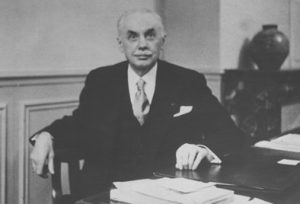 René Grousset. |
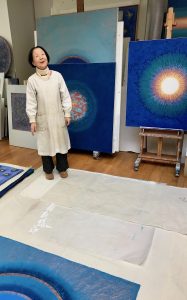 Bang Hai Ja in his studio. 2019. |
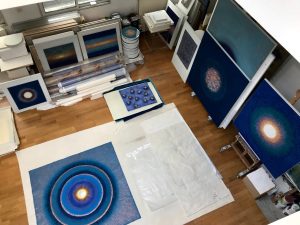 Bang Hai Ja workshop. 2019. |
Mael BellecThe chief curator and head of the Chinese and Korean collections at the Cernuschi Museum presented the Bang Hai Ja (1937-2022) archive, donated to the museum. He began by outlining the career of this remarkable and unassuming artist of Korean origin, who had welcomed the Friends of the Museum to her studio in 2019. Arriving in Paris in 1961, she attended the École des Beaux-Arts to familiarize herself with all the techniques. Returning to Korea from 1968 to 1976, she came back to France to settle, choosing to work exclusively with natural pigments on Korean mulberry paper. The creation of stained-glass windows for the Saint Piat Chapel in Chartres Cathedral crowned a lifetime of artistic exploration. Her works radiate light as if with an intense inner brilliance. The archive includes photographs of her exhibitions and those close to her, correspondence, catalogs, and designs, including those for the Chartres stained-glass windows. For CERAAF, it's a goldmine of information.
Anne FortThe chief curator and head of the Vietnamese collections began by presenting the career of Mai-Thu (1906-1980), a member of the first graduating class of the École des Beaux-Arts de l'Indochine. He settled in Paris in 1937, along with his compatriot and friend Lê Phô (1907-2001), who joined another artist, Vu Cao Dam (1908-2000). She then screened a film Mai-Thu made during Ho Chi Minh's visit to France. On September 2, 1945, Ho Chi Minh (1890-1969) proclaimed the independence of his country and the birth of the Democratic Republic of Vietnam. In 1946, he accompanied the Vietnamese delegation to France for the Fontainebleau Conference. He spent a considerable amount of time in France from May 31 to October 20 of the same year, during which he launched a major campaign to persuade non-communist public opinion to support the idea of a peaceful transition to independence. The goal of this campaign was the Fontainebleau negotiations, which, in July, ultimately led to nothing. The film retraces Ho Chi Minh's travels, meetings, and conferences. This document is of fundamental importance for understanding this complex period in Franco-Vietnamese relations, which would unfortunately lead to war on December 19, 1946.
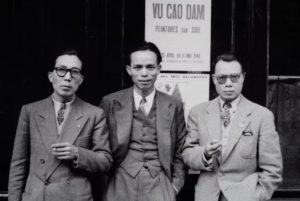 Mai Thu, Vu Cao Dam and Lé Pho. 1946.©Alain Le Kim Archives. |
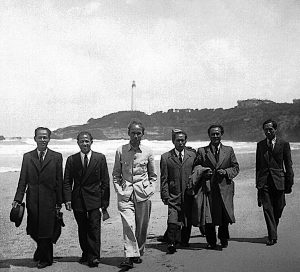 Ho Chi Minh.Biarritz.1946.©Keystone-France/Gamma-Keystone |
The second part of the day was dedicated to Takesada Matsutani, the guest of honor who was present in the room. Pierre-Gautier, doctor of art history, head of the Japanese collections at the Cernuschi Museum, introduced a screening of excerpts from interview films which allow us to become familiar with his philosophy of art and to see him create some of his works.
Born in Osaka, Japan in 1937, Matsutani trained in drawing and painting before attending, from 1959, the drawing workshop of the Nishinomiya Citizens' Art School, where he met Sadamasa Motonaga (1922-2011), one of the founding members of Gutai. Becoming a friend and disciple of Motonaga, Matsutani participated in Gutai group exhibitions from 1960 to 1972. Arriving in Europe in 1966, Matsutani experienced a profound culture shock and decided to travel to Greece, Italy, and the South of France, following in the footsteps of Western art history, before settling in Paris, where he made his permanent home in the late 1960s, while continuing to make frequent trips to his native country.
Vinyl glue became his preferred material, spread on cotton canvas and sometimes mixed with a building oil. Matsutani covered his canvases with circular shapes, bubbles of glue (some of which burst), which he created by blowing air into the material with a straw and then drying them with hairdryers or fans, allowing an element of chance in the movement the material took as it solidified. Matsutani drew some of his inspiration from organic forms, and a great sensuality, a latent eroticism, is also expressed in his works.
Elea Sicre, doctoral candidate, in charge of the catalogue raisonné of Matsutani's engraved work, in charge of the print collections of the 20rd-21rd The INHA library has been exhibiting the artist's engraved work for centuries. Upon arriving in Paris, Matsutani joined Atelier 17, run by Stanley William Hayter (1901-1988), where he became Hayter's assistant. There he learned the techniques of engraving, etching, and aquatint. In 1968, he also joined the silkscreen workshop founded by Kate Van Houten (born in 1940), who would later become his wife, and Lorna Taylor (born in 1941). Produced at Atelier 17, the etchings, aquatints, and engravings of 1967-1968 reflect Matsutani's personal explorations, combining organic forms (1967-1968) and the transposition of three-dimensional spaces (1968-1969). From 1968 onwards, the screen printing technique allowed him to explore two different directions: geometric shapes in flat areas of color and photo-screen printing transposing into gridded surfaces the works previously made using vinyl glue (1973-1977).
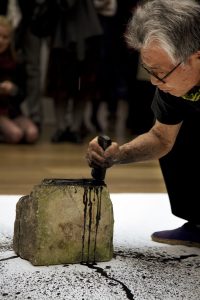 Matsutani performance. Hauser&Wirth Gallery.2013. ©Hauser&Wirth. |
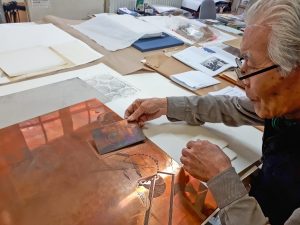 Matsutani in his Parisian studio, showing the two engraved copper plates, matrix of The Green Angle, 1968. ©Nathalie Muller.INHA. |
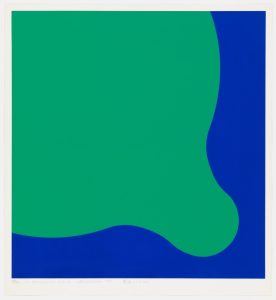 Takesada Matsutani. Propagation –S-4-A, silkscreen, 1969. ©Hauser&Wirth. |
Deborah Levy, a doctor of art history and exhibition coordinator at the Guimet Museum, invites us to discover the Gutai movement. This Japanese avant-garde art movement was founded in 1954 and dissolved after the death of its founder, Jirō Yoshihara (1905-1972). The term Gutai is a neologism meaning "the body as instrument" and the adjective gutaiteki The term "concrete" is opposed to "abstract." This movement highlights the importance of the material and the role of the artist's body. Performance and gestural painting were explored by the Gutai movement. It gives significant importance to site-specific works. It is often an ephemeral art form that survives only through photography or film. Generally, the works executed on canvas are very large. On most of them, cutting, tearing, dismembering, burning, projecting, throwing… are key elements.
Valerie DouniauxDr. [Name], a doctor of art history and director of the Shôen collections, revisits the artist's installations and performances with numerous photographs. These performances extend the radical exploration of matter and bodily gesture. They link the artist's physical action, breath, and time through mediums such as vinyl glue and graphite. With the series Stream (flux), he inaugurates another approach, imbued with Zen philosophy: the infinite repetition of small graphite strokes on very large surfaces is like a very simple contemplative act, yet remarkable for its persistence and its ability to stretch time. He works on large strips of paper, one end of which is sometimes "washed" with turpentine or white spirit to test the unpredictability of matter in real time.
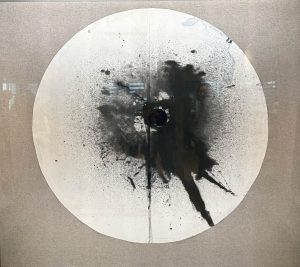 Takesada Matsutani. Circle – Cernuschi. Ink, graphite pencil lead and vinyl glue on canvas. 2026. |
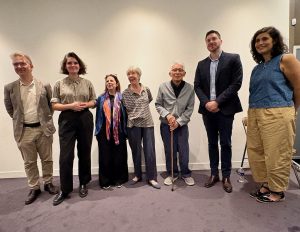 Éric Lefebvre, Deborah Levy, Valérie Douniaux, Kate Van Houten, Takesada Matsutani, Pierre Gautier, Éléa Sicre. |
For Circle – CernuschiMatsutani reused a canvas that had served, in the 1990s, as the support for one of his performances around the sumi (India ink). To do this, he usually suspends a bag filled with a solvent above a large stone, itself placed in the center of a canvas spread on the ground. The bag is then pierced, allowing drops to escape. The artist then rubs an ink stick on the wet stone. Little by little, a flow of ink begins to run down it. The black splashes, speckled Circle – Cernuschi constitute the reminiscences of this past action. The artist continued the work from 2025 by adding a dome of vinyl glue and lines drawn with graphite pencil, thus modifying this surface by giving it a new historicity.
« Yes, in the end, I hope I have remained true to the Gutai motto, to constantly strive to do "what has never been done," and to the Gutai principle of engaging in dialogue with matter, allowing chance and spontaneous gestures to intervene..» (comments collected by Valérie Douniaux in Interview with Takesada Matsutani.)