
Mingei Bamboo Prize
Guided tour of the Mingei Gallery.
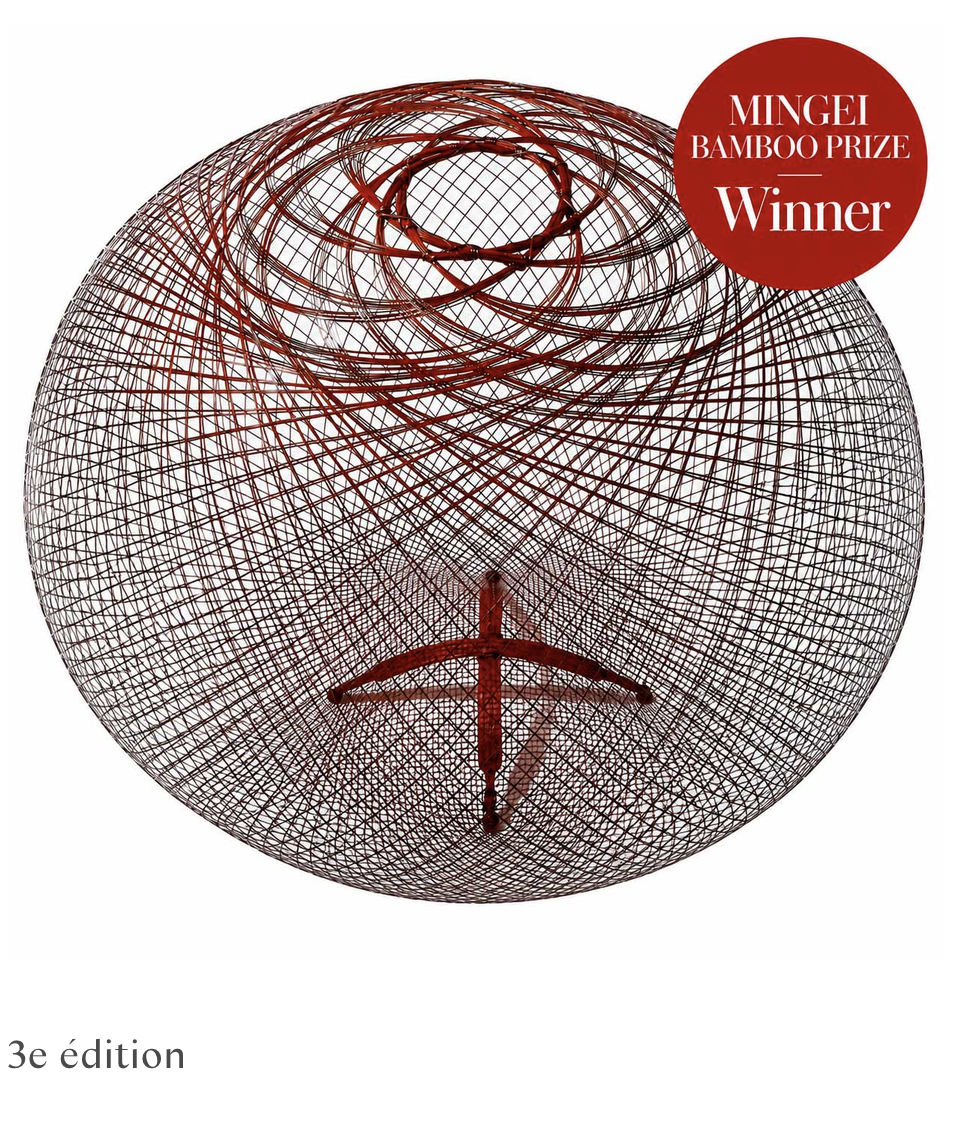
This visit was dedicated to the third edition of the Mingei Bamboo Prize, created in 2021 in partnership with the Guimet Museum and organized this year with the Quai Branly – Jacques Chirac Museum.
This prize aims to support and promote Japanese bamboo art as well as contemporary creation in this field.
Japanese artistic basketry developed primarily from the late 19th century onwards.rd century, particularly in Osaka and several regions of northern Japan. During the Edo period (1603-1868), baskets used for ikebana and the ceremony of sencha were still largely imported from China and appreciated by Japanese scholars.
The decrease in these imports gradually favored local production inspired by Chinese models, designated as karamono utsushiFrom the 1860s onward, Japanese artisans also began signing their works, giving them a true artistic identity. For nearly a century, these objects remained primarily functional, intended mainly for floral arrangements, before artists gradually moved beyond this use. Bamboo thus became the material for independent sculptural works, also influenced by modern styles, notably American fiber art and certain Native American traditions.
For the 2026 edition of the prize, a call for submissions launched in Japan attracted 31 artists, from which 14 works were selected based on criteria of technical mastery, innovation, and creativity. Several of the selected artists come from the studio of Tanabe Chikuunsai IV, one of the few Japanese workshops still providing genuine apprenticeship training. The apprenticeship is particularly demanding: at least three years of training are required before one can truly begin the work of weaving. Japan has approximately 600 varieties of bamboo, but only about fifteen are commonly used in this art; some works notably utilize the yadakeBamboo, once used to make samurai arrows, can be dyed before weaving, and the finished piece is then lacquered; the joints are sometimes made with rattan imported from Thailand. Each piece has a title and a signature, which constitute both its identity and a kind of "pedigree" allowing its author and provenance to be traced.
The exhibition thus showed the progressive transformation of a utilitarian craft into a fully-fledged contemporary art, now collected by museums, private collectors and ikebana specialists.
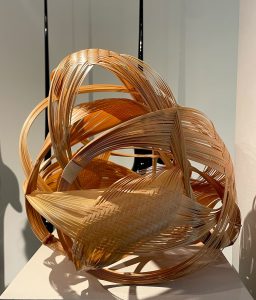 IKEDA Yoshihiro. Ryūseki (Particle wake). 2025. Madake bamboo, rattan, Tabane-ami and ajiro-ami. © Maëlle Schmitt. |
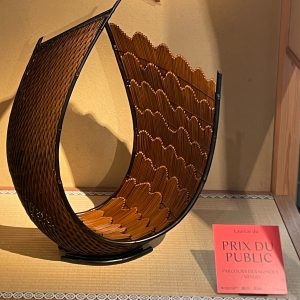 HONMA Hideaki. Ryūmon II (Waves II). 2024. Madake and nemagaridake bamboos, rattan and urushi lacquer. © Maëlle Schmitt. |
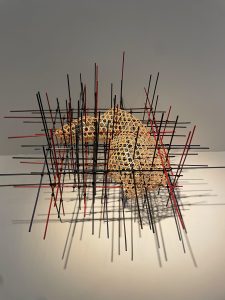 SHIMIZU Takayuki. Baku “Enslavement”. 2025. Madake bamboo, rattan, Mutsume-ami urushi lacquer, six-link braiding and through lacquered strips. © Maëlle Schmitt. |