
Knowledge as an illusion. Korea, 18th-20th centuries.
Exhibition from September 16, 2026 to January 4, 2027 at MNAA-GUIMET.
What use is a library when there is not enough time to read? At a time when knowledge circulates on screens, escaping through reading sometimes becomes a luxury and the library is then often more looked at than used.
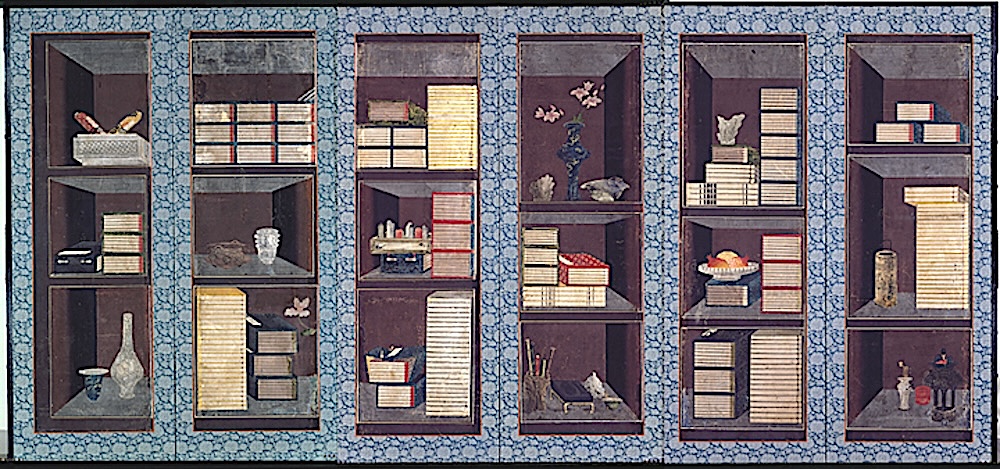
This dilemma is not new. In late 18th-century Korea, King Jeongjo (r. 1776-1800) already faced it. Engrossed in affairs of state and with little time to read, he commissioned the official artists of the Royal Academy of Painting to create a folding screen depicting his library in trompe-l'oeil, so he could remain close to his books. He thus found in contemplating this painting a way to symbolically remain surrounded by his books: a trompe-l'oeil extending the spirit of the study, stimulating virtue, curiosity, and scholarly conversation.
Korean embassies in Beijing then played a decisive role. Joseon envoys discovered Chinese treasure cabinets there, as well as the Jesuit art of perspective, disseminated at the Qing court and in the churches of the imperial capital by European artists. The alliance between Chinese scholarly accumulation and European expertise in trompe-l'œil fueled the inventiveness of Korean painters, who developed a unique use of perspective, the chaekgeori.