
Laos: Sovereignty as a key issue for a landlocked country
Conference ofAnne Fort, chief curator of heritage, in charge of Southeast Asia and Central Asia at the Cernuschi Museum.
Not only the borders of present-day Laos, but also the contemporary understanding of the term "Laos" itself, are the result of a succession of political events summarized in this lecture, conceived in conjunction with the annual trip of the Society of Friends of the Cernuschi Museum. Nestled in the mountainous forests of Southeast Asia, landlocked, modern-day Laos reflects the multitude of influences of the great kingdoms that have succeeded one another within its territory. Within the sphere of influence of the Champa kingdom and then the Khmer kingdom in its early period, Laos found itself, from the 11th century onward, at the heart of the Thai cultural sphere. Incorporated into French Indochina at the end of the 19th century, the country suffered Japanese occupation and American bombing during the 20th century, while simultaneously navigating internal political struggles and the covetousness of its Thai and Vietnamese neighbors.
Geography and population of Laos. The country, one of the poorest in Southeast Asia, is sparsely populated, and its mountainous terrain hinders population growth. Furthermore, it is the only landlocked country on the peninsula. Its population is among the most culturally diverse: officially, 50 ethnic groups are recognized, but when considering the various subgroups, the number reaches as high as 130. Another distinctive feature of Lao ethnic identity is its distribution, which does not follow national borders: six times more Lao people live in Thailand than in Laos. This can be explained by the waves of deportation of Lao populations to the northern and northeastern regions of present-day Thailand during the frequent wars between the kingdoms of Vientiane and Luang Prabang and Siam, beginning in the late 18th century. At that time, a kingdom's wealth depended primarily on its population, the size of which allowed for greater tax revenue, both on crops and in terms of manpower to bolster the army. The deportations of the Lao population by Siam, on the contrary, weakened their territory of origin.
La Plain of Jars This testifies to the ancient settlement of Xieng Khouang province, a crossroads between east and west thanks to a pass in the Annamite Cordillera. The megaliths, shaped like jars, are grouped at several sites and were mostly carved between 500 BC BC and 500 AD AD Madeleine Colani was the first to publish her research on this site in 1935 with the support of the École française d'Extrême-Orient (French School of Asian Studies). The diversity of burial types—cremation followed by the placement of calcined remains or inhumation—as well as recent analyses, suggest that the site was used continuously by peoples of different cultures until the 19th century. In the 13th century, the principality of Phuan was founded there. The Phuan were a branch of the larger Tai ethnic group, originally from southern China, who gradually migrated southward from the 8th century onward, pushing the already present Mon-Khmer populations into the mid-altitude areas. The Tai followed the valleys where they practiced irrigated rice cultivation. The principality of Phuan is one of the oldest Tai city-states in Laos. There remain some vestiges of its capital Muang Khoun, notably the Wat Phia Wat temple founded in 1322 where a monumental Buddha in the open air and some columns recall the pillaging by armed Chinese bands defeated by the Qing at the end of the 19th century and then the destruction caused by the French and then the Americans during the two Vietnam wars.
The ancient kingdoms and the Mon-Khmer power. The kingdoms of Funan (1st-7th centuries) and then Chenla (6th-8th centuries) developed on the southern tip of the peninsula and assimilated the cultural contributions of merchants and monks from India. The kingdom of Angkor absorbed Chenla in 802. The hillside temple of Wat PhuNear Champasak, this site bears witness to this early influence in southern Laos. The complex dedicated to Shiva dates from the 11th century and is in the Khmer style. The town built below, on the banks of the Mekong, dates back to the 5th century, to the Chenla period.
The great migration of the Tai: 8th – 13th century. Driven southward by Chinese pressure, the Tai people gradually settled in northern Southeast Asia, encompassing present-day Burma, Thailand, Laos, and Vietnam. Their warlike customs allowed them to gain dominance over the existing populations, while simultaneously adopting the royal traditions, administrative vocabulary, and Theravada Buddhism (from the 13th century onward) of the Angkor kingdom. In the 13th century, the Mongol conquest accelerated migrations from north to south and disrupted the balance of power: the Pagan kingdom (849-1297) in Burma never recovered, while the Tai people entered the annals of history by federating into principalities, the "muang," or agricultural city-states. The Sukhothai Kingdom (1238-1438), located in the heart of modern-day Thailand, was the first independent Tai kingdom. Its ruling dynasty, descended from Tai chiefs, established its authority over a population comprised of Tai, Mon, and Khmer peoples. It strategically preserved its integrity by pledging allegiance to the Mongol Empire.
The Lan Xang kingdom (1353-1707). Laos enters history with the annals of the Lan Xang Hom Khao kingdom, or the kingdom of the "million elephants and the white canopy," two symbols of power. Its founder, Fa Ngum (r. 1353-1373), was a prince of Muang Sua (present-day Luang Prabang) exiled by his grandfather to the court of the king of Angkor, whose daughter he would later marry. With the support of the army provided by his father-in-law, he set out to reconquer Muang Sua and established the Pha Bang (which would give its name to the capital Luang Prabang, "City of Pha Bang"), a Buddha statue offered by the king of Angkor, and massively promoted Theravada Buddhism in Laos. The Lan Xang reached its zenith in the 16th century, under the reign of Setthathirath (1548-1571), is marked by its resistance to the offensives led by the Burmese king Bayinnaung (r. 1550-1581). Setthathirath had the following built in his capital of Luang Prabang: Wat Xieng Thong. in 1560. This “temple of the City of Gold”, although regularly restored, is the oldest and most representative of Lao architecture, with its masonry terrace and its wooden superstructure whose widely overhanging roof, with superimposed curved sides, tapers towards the sky and descends very low towards the terrace.
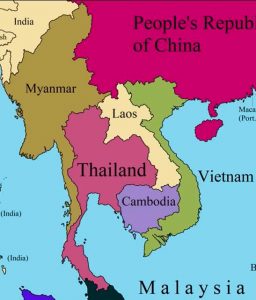 Laos is landlocked between six countries. |
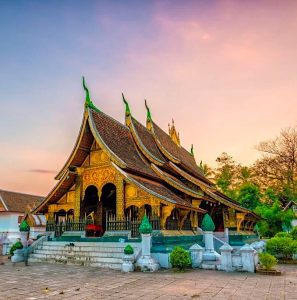 Wat Xieng Thong. Luang Prabang, 1559-1560. |
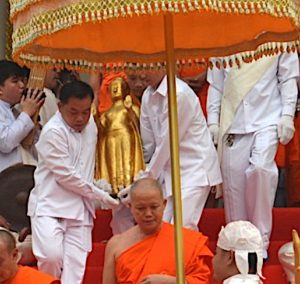 Procession of the Phra Bang during Pi Mai (Lao New Year). Luang Prabang, since 2013, from Haw Pha Bang to Wat Mai. |
Faced with the Burmese threat, Setthathirath changed his capital and established himself in Vientiane (Viang Chan, "the city of the moon/sandalwood"). Among the many buildings founded or restored during his reign, the Pha That Luang is the most sacred. According to tradition, it was founded in the 3rd century BCE to honor a relic of the Buddha brought by emissaries of the Indian king Ashoka. Setthathirath had it restored and added thirty small stupas to the second level, symbolizing the union of the various principalities of Lan Xang. In 1818, the king of Vientiane, Anouvong, added a gallery and four eastern gates, some of which are still preserved.
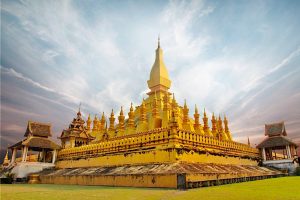 Pha That Luang. Vientiane, 1566 (restored by Setthathirat), 1818 (gallery and gates by Anouvong). |
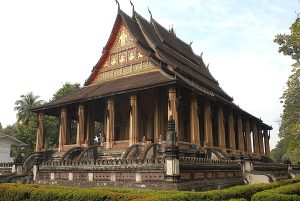 Wat Phra Keo. Vientiane. 1566 (restored by the French School of the Far East - 1942). |
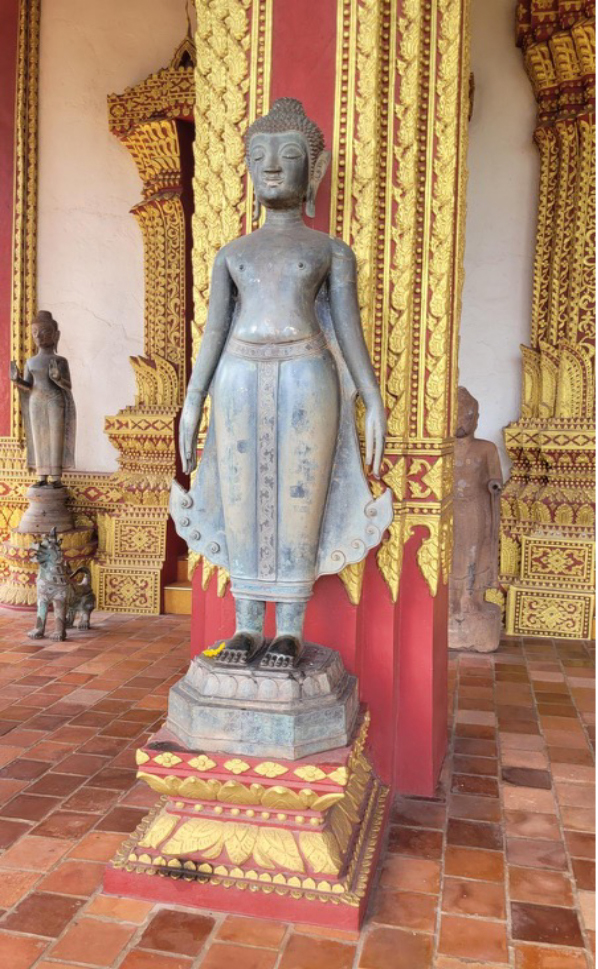
The following was completed in 1566 Wat Phra KeoThe temple was intended to house the Phra Keo, the Emerald Buddha, a jade statue that miraculously appeared in 1434 in the Lanna Kingdom, a Tai kingdom in what is now northeastern Thailand. It passed by inheritance to Setthathirath in 1551. The king of Lan Xang then took it to Luang Prabang and later to Vientiane, where his new temple was built. In 1778, Siam attacked Vientiane and seized the Emerald Buddha, which became the protector of the country from the capital, present-day Bangkok, where it remains today. Wat Phra Keo was destroyed in 1779 by Siamese troops, then rebuilt in 1818 by Anouvong, and destroyed again in 1828 when the entire city of Vientiane was razed by Siam. It was rebuilt between 1936 and 1942 by the French School of the Far East (École française d'Extrême-Orient) according to old plans, with a superstructure in the 19th-century Siamese style. Since the 1970s, it has housed a sculpture museum. The other palladium in Laos, the Phra BangThe Phra Bang, or Golden Buddha, had a similar fate to the Emerald Buddha. Emblematic of the founding of Lan Xang, it was venerated in Luang Prabang until 1705, when it was moved to Vientiane. In 1778, it was also taken to Bangkok as war booty, but was returned four years later after being blamed for a series of misfortunes that befell the Siamese capital. In 1828, when Vientiane was destroyed by Siam, the Phra Bang was again taken to Bangkok, but was returned 39 years later to Luang Prabang, following another series of disasters. It is kept at the Wat Mai from 1889 to 1941, then at the National Museum of Laos, and today in the Haw Pha Bangbuilt in 2006 within the grounds of the royal palace.
Breakup of Lan Xan; Burmese and Siamese threats (1707-1893). The 16th century, marked by Burmese raids, opened onto a peaceful 17th century, which ended with the collapse of the Lao city-state federation following the succession crisis of the last king of Lan Xang, Surigna Vongsa (1638-1694). In the 18th century, each muang Luang Prabang, Vientiane and Champasak, although sharing a common culture and past, do not unite against Burmese threats (3e quarter of the 18th century) then Siamese (late 18th and 19th centuries). The two powerful neighboring kingdoms developed a system of political alliances to divide the Lao principalities to their advantage. Large waves of deportation of the Lao population by Siam were organized from the last third of the 18th century. The last king of the Vientiane kingdom, Anouvong (1767-1829), rebelled against his Siamese overlord, but the revolt was crushed in 1828, the city was razed, and the entire population was deported to northeastern Thailand. Only Pha That Luang and the Vat SisakhetThe temple, built in 1824 in a Siamese style, is spared.
The French protectorate and the path to independence (1893-1975). In the 19th century, Burma was at war with the British, who eventually annexed it in 1885. Siam maintained its independence and sought to annex all the Lao principalities. It also coveted Cambodia and opposed Vietnam, which also coveted it. In 1863, the King of Cambodia accepted a French protectorate to counter the Siamese and Vietnamese. France's colonization of Cochinchina in 1862 and its protectorates over Tonkin and Annam in 1887 exacerbated tensions between France, Siam, and China, the latter refusing to see Vietnam leave its sphere of influence. In 1893, the Franco-Siamese Crisis erupted: lacking British support, who wanted Siam to remain a buffer state between their Burmese colony and French Indochina, Siam was forced to yield to French military force. The territory of present-day Laos effectively became a French protectorate in 1893, and administratively in 1899. The French, in a position of superiority over the Siamese, could have negotiated for the territories of northern and northeastern Thailand, populated by Lao people, but the creation of a nation-state was not their priority; Laos served as a buffer state between themselves and Siam. The cities of Luang Prabang and Vientiane were rebuilt in the French colonial style, employing Vietnamese masons. The King of Luang Prabang and his court were maintained using funds from the Ministry of Colonies, which built him a new royal palace in 1904. The French allowed the dynasties of the other principalities to remain in place, but recognized the primacy of the Luang Prabang dynasty.
The Japanese coup in March 1945 led to the collapse of French authority in Indochina. Laos's independence was gradually recognized by France in 1946 and 1949, and definitively established in 1954. The monarchy of independent Laos, closely aligned with the French, remained in place until its abolition on December 2, 1975. The communist faction then seized power. The country's fate closely mirrored the events unfolding in neighboring Vietnam. Theravada Buddhism was reshaped between 1975 and 1979 by the communist regime: almsgiving to monks was forbidden, they were required to work, they were supervised by the state, and the concept of karmic retribution was outlawed. Many monks went into exile in Thailand, while others were sent to re-education camps. But from 1980 onwards, the government softened these measures so as not to alienate a very devout population. In 1991, the Pha That Luang replaced the hammer, sickle, and star on the country's official emblem, with Buddhism once again being asserted as a fundamental element of Lao identity.
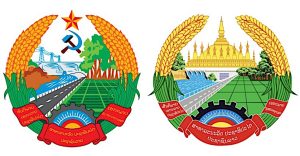
Emblems of Laos between 1975 and 1991 and from 1991 onwards.