
The Seokguram Cave: The Millennial Secret of Buddhist Art
Exhibition from October 2, 2026 to March 6, 2027 at the Korean Cultural Center20 rue la Boétie, 7508 PARIS
To mark the 140th anniversary of diplomatic relations between Korea and France, the Korean Cultural Center, the Korea Heritage Service, the city of Gyeongju, and the National Research Institute of Cultural Heritage present an exhibition dedicated to the Seokguram Grotto, a UNESCO World Heritage Site located in Gyeongju, the former capital of the Silla Kingdom. Through this iconic site, the exhibition invites the public to discover the Buddhist art that flourished during this period.
Located in the southeast of the Korean Peninsula, Gyeongju was the capital of the Silla Kingdom for nearly a thousand years (57 BC – 935 AD). It is home to numerous archaeological sites and remains that testify to the rich culture and traditions of this period.
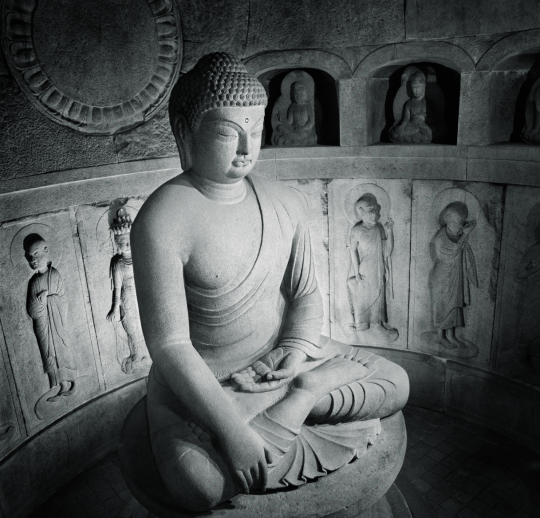
Seokguram, located on Mount Toham in Gyeongju, is an artificial grotto constructed from finely cut granite blocks assembled with remarkable precision. A true masterpiece of Buddhist art from the unified Silla kingdom (668-935), it testifies to the artistic refinement, architectural mastery, and openness to the world that characterized this period. In 1995, Seokguram was inscribed on the UNESCO World Heritage List in recognition of its exceptional heritage value.
This exhibition was designed to offer visitors a more immersive experience of Seokguram, a true jewel of Silla culture and a reflection of the Buddhist universe. It showcases the monument's original architecture and remarkable construction techniques. Thanks to photographs by Han Seokhong, who dedicated his life to capturing Korean cultural heritage, visitors can also appreciate the beauty of the sculptures that adorn the cave. Among them, the statues of monks, bodhisattvas, and Buddhas attest to the sacred dimension of religious art.
The exhibition also offers an immersive and sensory experience through various digital and educational tools. An LED screen allows visitors to discover Gyeongju's main historical sites, including Bulguksa Temple and Seokguram Grotto, while braille displays and tactile elements invite visitors to explore the artworks through touch. These different approaches thus offer a tangible and accessible exploration of Korean cultural heritage.