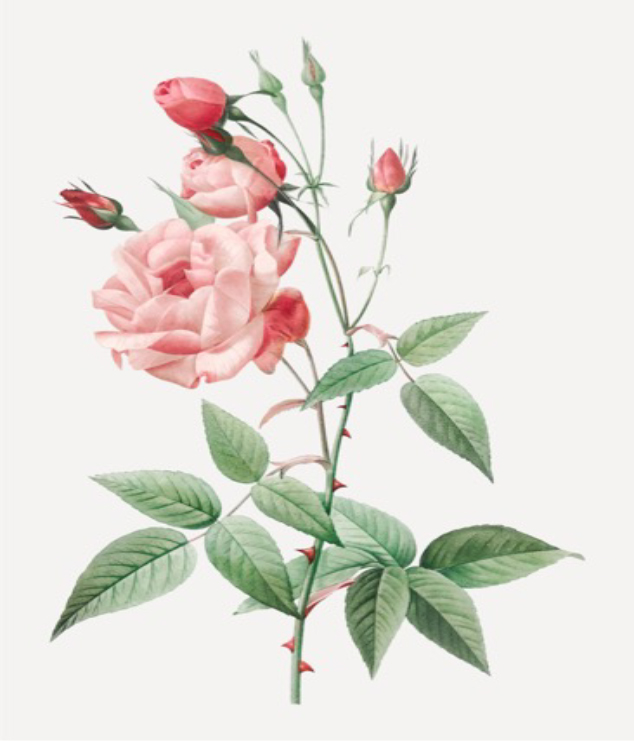

From the mountains of Sichuan to the gardens of Malmaison: the history of the Chinese rose in France, between the search for Chinese otherness and the construction of a French identity
Conference by Diane Margerit, a graduate of the École Normale Supérieure, specializing in history and geography, and a senior civil servant, having worked in the field of urban planning and heritage.
Diane Margerit emphasizes the importance of the history of the Chinese rose and its often overlooked role in the transformation of horticulture and garden design in France, through cultural transfers and aesthetic reinterpretations between China and Europe, from the 18th century onwards.rd century to the present day.
From the European rose to the unique character of Chinese roses
Diane Margerit began by recalling how the European rose-growing landscape had remained relatively stable until the 18thrd century. The roses cultivated in Europe at that time derived mainly from a limited number of ancient species and groups—Gallic roses, Damask roses, white roses, or centifolia roses. Long used more for their medicinal properties than for their ornamental value, they occupied a rather modest place in medieval gardens, and later in the highly structured compositions of the Renaissance and the 17th century.rd century.
Their brief flowering period and relatively free-growing habit were ill-suited to the geometric principles of the French formal garden. At Versailles, in particular, the rose did not yet occupy the prominent place it would acquire in the following century. Furthermore, European varieties offered a still limited range of colors, essentially consisting of white and various shades of pink.
The situation in China was profoundly different. Rose cultivation is documented there for a much longer period, and horticultural practices developed early. Among the various roses cultivated in China, Rosa chinensis, known in Chinese as yueji (月季), literally associated with its regular flowering, stood out. Texts by Chinese scholars from the 16th century onward mention this rose.rd and 17thrdCenturies have already borne witness to this remarkable property: where the majority of roses only bloom once a year, this Chinese rose has the ability to bloom again during the same season.
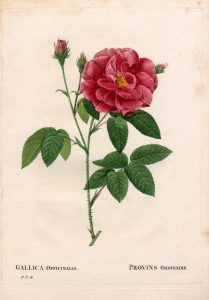 Pierre-Joseph Redouté. Rosa gallica officinalis (Rose of Provins). Intaglio engraving. |
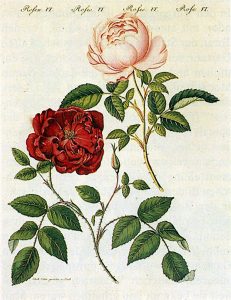 Friedrich Justin Bertuch (1747-1822). Rosa chinensis. Engraving. 1795. |
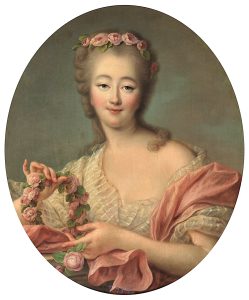 François-Hubert Drouais (1727-1775). Portrait of Madame du Barry. Oil on canvas. 1770. |
This repeat flowering, resulting from an ancient genetic mutation and transmitted through successive hybridizations, was to play a decisive role in the global history of the rose. Contemporary research places one of the major centers of diversification for these roses in southwestern China, particularly in the Sichuan Basin. In addition to their repeated flowering, other characteristics impressed European observers: deeper reds, orange or yellow tones, more slender buds, dark and glossy foliage, and a generally lighter and more elegant form than that of European roses.
The European Discovery of Chinese Gardens
This botanical discovery is part of a larger movement: the European fascination with Chinese gardens.
From the early modern period, the accounts of Jesuit missionaries had helped to popularize a conception of the garden quite different from the French geometric design. In the 18th centuryrd century, the descriptions of Father Jean-Baptiste Du Halde (1674–1743), then those of Jean-Denis Attiret (1702-1768), Jesuit painter in the service of Emperor Qianlong, met with considerable impact in Europe.
Attiret, who had observed the imperial gardens of Beijing, notably described in 1749 a landscape designed to be discovered gradually, as one strolled through it. In contrast to the axial perspective and geometric mastery characteristic of the French formal garden, the Chinese garden relied on a subtle succession of scenes, detours, openings, and concealments. Landforms and waterways played a structuring role, reflecting a philosophy of landscape informed in particular by the principles of... feng shuiThe plant life did not necessarily constitute the center of the composition: it participated in a larger whole in which architecture, water, rock and vegetation composed a reconstructed and idealized nature.
From the mid-18th centuryrd In the 19th century, these descriptions contributed to the European development of the so-called "Anglo-Chinese" garden. The achievements of William Chambers (1723–1796) in England, notably at Kew, and then the publications of Georges-Louis Le Rouge (1712–1790) in France with his fashionable Anglo-Chinese Gardens, widely disseminated a landscape imaginary presented as Chinese, but largely reinterpreted according to European sensibilities.
The evolution thus took place in two stages: even before the massive arrival of Chinese roses, Europe had begun to adopt a landscape framework that it associated with China. Plants then came to take their place in this recomposed world.
Women, flowers and the renewal of taste in the 18th centuryrd century
One of the particularly interesting contributions of the conference was to place aristocratic women at the heart of this transformation of taste. The traditional history of botany has often privileged scholars, collectors, and nomenclators; however, the cultural history of gardens allows us to highlight other actors in the dissemination of plants.
Au 18rd In the 19th century, alongside the growing scientific interest in exotic species, flowers acquired a new place in aristocratic culture. Gardens became more like spaces to explore and inhabit: places for entertaining, relaxing, and hosting social events. In the decorative arts as well as in portraiture, floral motifs proliferated, and the rose gradually acquired meanings associated with femininity, beauty, emotion, and intimacy.
Madame de Pompadour (1721-1764) and Madame du Barry (1743-1793) were often depicted surrounded by flowers. But Queen Marie Antoinette (1755-1793) took this trend to a new level. At the Petit Trianon, the Hamlet, the Queen's Grove, and especially at Saint-Cloud, she gave considerable prominence to floral arrangements and roses. The watercolors and paintings of Louis-Claude Châtelet (1753-1795) still allow us to understand this transformation of the aristocratic garden, in which flowers, and especially roses, serve as a transitional element between lawns, groves, water features, and follies.
This evolution in taste immediately preceded the arrival in Europe of repeat-flowering Chinese roses. It therefore created the cultural conditions necessary for their reception.
The arrival of Chinese roses and the decisive role of Malmaison
At the end of the 18rd In the 19th century, British merchants from the East India Company became the main intermediaries in the introduction of Chinese roses to Europe. In Canton, then the main authorized point of contact between European merchants and Chinese trade, the Fa Tee nursery supplied several cultivars that would profoundly transform Western horticulture.
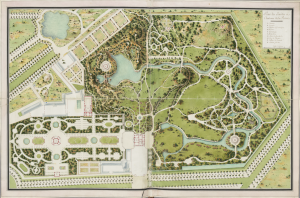 Claude-Louis Châtelet (1753-1795). Plan of the garden and the Queen's château (Petit Trianon) at Versailles, reproduced by Georges Louis Le Rouge, Anglo-Chinese Gardens: 10th booklet, Paris, Le Rouge, 1783. Engraving. Between 1770 and 1795. |
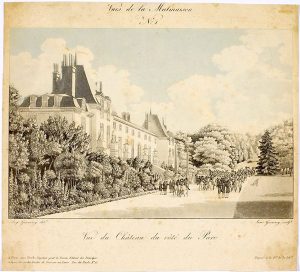 Auguste Simon Garneray (1783-1857). View of the Château de Malmaison next to the park. Aquatint. © MDDS. |
Among them were the famous Slater's Crimson China, introduced in 1792, then Parsons' Pink China, soon followed by roses belonging to the tea rose group. Their repeat flowering, their colors, and their delicate form were all new characteristics for European horticulturists.
The spread of these roses in France was, however, delayed by the wars and blockades between France and England. It is in this context that Joséphine de Beauharnais (1763-1814) acquired a decisive importance.
At Malmaison, Josephine assembled an exceptional collection of plants and roses. Her interest in horticulture combined the aesthetic taste inherited from the 18th century.rd century with an approach strongly linked to the natural sciences. Botanists, gardeners, nurserymen and artists frequented the estate, which became a place for collection, experimentation and dissemination.
Initially, lacking regular access to Chinese roses, Josephine helped stimulate the improvement of old European roses. Nurserymen like Jacques-Louis Descemet developed new, more ornamental varieties, several of which are still cultivated today.
Josephine then managed to obtain roses from China from English nurserymen, despite the blockade. The introduction of this new plant material broke the genetic isolation of French roses. Most importantly, the Empress did not jealously guard her collections: plants and knowledge circulated among French and Belgian horticulturists, fostering new hybridization experiments.
The work of Pierre-Joseph Redouté (1759-1840) is inseparable from this undertaking. His three volumes of Roses, published at the beginning of the 19th centuryrd century, constitute both a monument of botanical illustration and a formidable instrument for disseminating the taste for roses. Old European roses, Chinese roses and new creations are brought together in a single undertaking of knowledge and representation.
Malmaison thus appears as a pivotal place: the Chinese rose gradually ceases to be just a foreign plant and becomes one of the materials from which a new French horticulture is built.
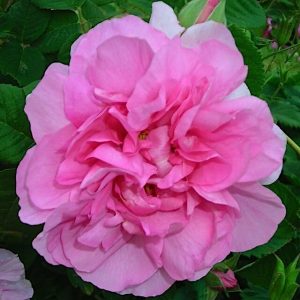 Impératrice Joséphine is a cultivar of Gallic rose obtained before 1815 by Jacques-Louis Descemet (1761-1839). |
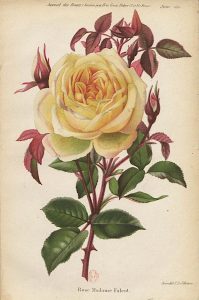 Madame Falcot is a rose cultivar obtained in 1858 by François Guillot fils. Engraving from the Journal des roses. 1880. |
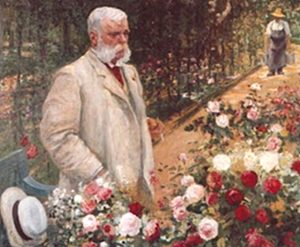 Portrait of Jules Gravereaux in the Rose Garden of L'Haÿ. Anonymous. Oil on canvas. |
From hybridization to the birth of the modern rose
Throughout the 19thrd In the 19th century, French horticulturists and rose growers continued this work of hybridization. The crossing of European and Chinese lines made it possible to gradually combine traits that were previously separate: repeat flowering, color diversity, elegance of the bud, vigor and resistance.
The Lyon region became one of the main centers of this innovation. Rose-growing dynasties were established there, including the Guillot family. In 1867, Jean-Baptiste André Guillot (1827-1893) developed the rose 'La France', generally considered the first modern hybrid tea rose. This creation symbolically marks a major turning point in horticultural history: the modern rose was born from the synthesis of the qualities of European roses and the genetic heritage of Chinese roses.
From the 1880s onwards, hybrid teas experienced considerable expansion. At the same time, the modern rose garden appeared, a space dedicated to the collection as much as to the aesthetic display of roses.
At the end of the 19rd In the 19th century, Jules Gravereaux (1844-1916) played a major role in this regard. In L'Haÿ-les-Roses, he assembled a collection of several thousand rose bushes, arranged in a veritable landscape architecture composed of pergolas, flowerbeds, water features, and garden rooms. He also contributed to the creation or development of several large French rose gardens, notably at Bagatelle.
The paradox then becomes clear: what is considered the quintessence of French horticultural art owes a significant part of its characteristics to a plant from China. The assimilation is so profound that its foreign origin eventually disappears behind the new identity of the varieties created in France.
From transfer to synthesis: a story of cross-influences
Au 20rd However, in the 19th century, a movement of aesthetic distancing from tea hybrids began. In England in particular, some breeders sought to recapture the fuller appearance, powerful fragrances, and generous shapes of old European roses.
After the Second World War, David Austin (1926-2018) continued this research. His first major creation, Constance Spry in 1961, drew on old French lines. With Gertrude Jekyll, created in 1986, he succeeded in combining the appearance and fragrance of old roses with the repeat flowering sought in modern varieties. This latter quality, however, remains partly inherited from Chinese lines. Even when one claims to distance oneself from the Chinese rose, its genetic heritage therefore persists in new creations.
Today, China is rediscovering its heritage of ancient roses, developing a thriving industry with strong government support, while asserting its cultural identity through dedicated gardens and museums.
The story recounted by Diane Margerit thus invites us to go beyond a linear reading of transfers between China and Europe.
The so-called "French" rose is partly Chinese; some roses presented as "English" are derived from French lines themselves inherited from crosses with Chinese roses; contemporary horticultural practices in China in turn draw on a global history of selection and hybridization.
From the ancient mutation that appeared in southwestern China to the French rose gardens of the 19thrd In the 19th century, the rose thus emerged as the product of a long history of exchange. Its journey illuminates both the evolution of botanical sciences, the transformations of garden design, and the mechanisms by which a society receives, transforms, and then integrates an element from elsewhere. Far from being anecdotal, the history of the Chinese rose reveals how the construction of a national horticultural tradition can proceed through appropriation, hybridization, and ultimately, the partial erasure of its foreign origins.