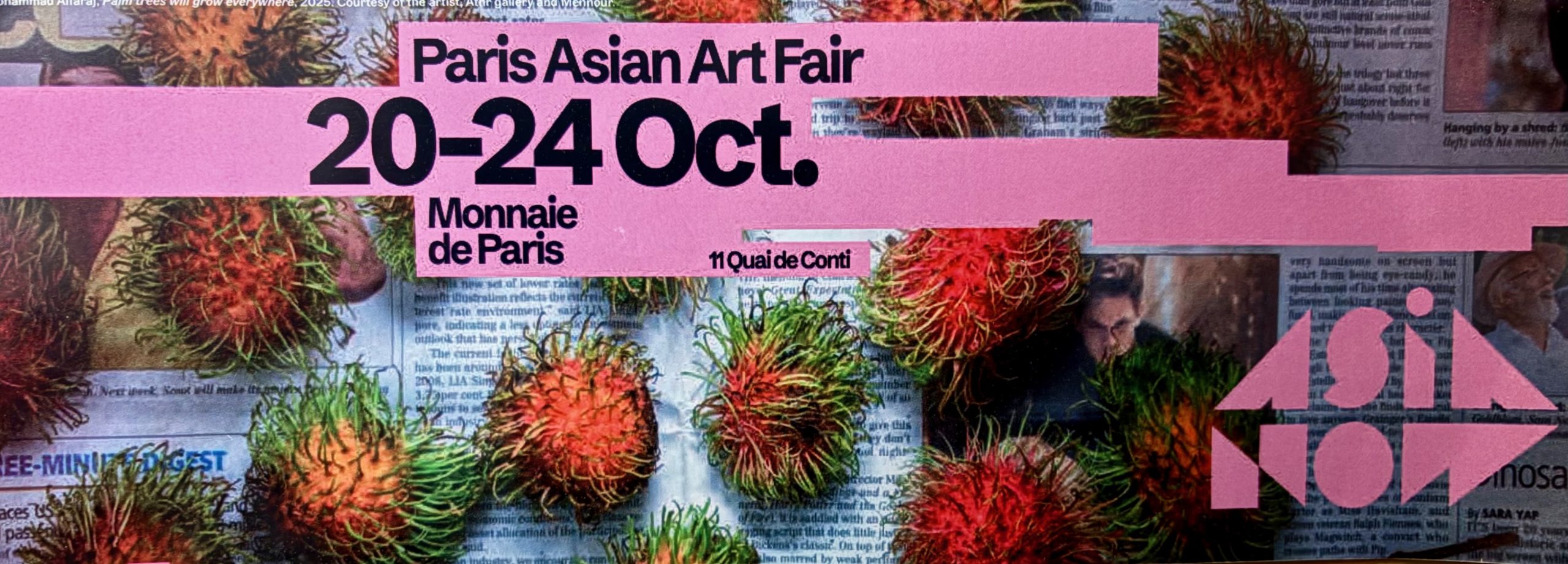

Asia NOW
Guided tour of the Paris Mint.
« An art fair conceived as a platform dedicated to the artistic voices of Asia and its diaspora. For over a decade, Asia NOW has been working to transcend the boundaries that have long defined East and West. Guided by a decentering approach—initiated by the “My East is Your West” project—the fair explores the blind spots of traditional art fairs, which are often limited to the role of mere incubators. We challenge established perspectives, amplify quieter voices, and open a space where Asia is not just a geography, but a methodology—a movement. » (Asia NOW).
Placed under the theme "Sentimental value" (Sentimental value) and exploring the concept of "Global Asias"The 2026 exhibition explores memory, transmission, and migratory dynamics.
More than 200 artists from Asia and its diaspora are showcased through some sixty international galleries, institutions, and private foundations. The event includes paintings, sculptures, installations, photographs, ceramics, as well as live performances and specific curatorial projects.
As every year, the Friends were invited on a guided tour of this ultra-contemporary Asian art fair. Our charming guide showed us a selection of galleries where the gallery owners, like Françoise Livinec, discussed the works and introduced the exhibiting artists. Some of the artists, present at their gallery's booth, were able to explain their artistic approach themselves.
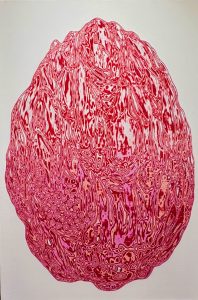 Jang Kwang Bum. Rock. 2024. Sanded acrylic on canvas. 120 x 80 cm. Galerie Françoise Livinec. |
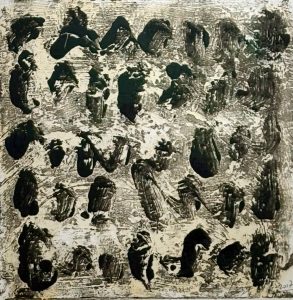 Ma Kelu. ADA. 2017. Oil on canvas. Espace-temps Gallery. |
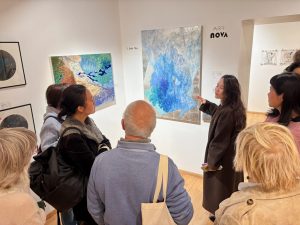 I-jen Su commenting on State 04. Mineral and plant pigments, silver leaf on linen paper. 2022. 90 x 125 cm. Art Nova Gallery. |
To name just a few artists who have been discussed or met:
Jang Kwang-Bum (born in 1972 in Seoul), at the Françoise Livinec Gallery booth. Initially, he paints thousands of monochrome layers on the same canvas over several months. After a very long drying time, he sands the paint to bring out the rhythm of the composition, revealing allusions to the mountains surrounding Seoul or reflections in the water, blurring the lines between abstraction and figuration. A long and meditative process with a subtly refined result.
At the Espace-temps Gallery, we met the Chinese artist Ma Kelu (born in Shanghai in 1954). He is a major figure in Chinese avant-garde art and was one of the founding members of the clandestine collective. No Name Group (The Nameless group) in the 1970s, openly opposing the socialist realism imposed by the government. After living and working in New York in the late 1980s, he returned to settle in China in 2006. His style has evolved from figurative plein air work to a powerful gestural and atmospheric abstraction, marked by large monochrome areas.
Alongside her visibility at Asia NOW, Ma Kelu is currently enjoying her very first solo exhibition in France at La cité de l'Architecture et du Patrimoine until January 3, 2027.
I-jen su (born in 1991 in Taiwan), a multidisciplinary artist, is part of the official selection presented by the German gallery Art Nova. She explained her artistic practice, which explores the perception, form, and transformation of matter through techniques of fragmentation, accumulation, and reconstruction. She primarily uses natural mineral pigments, plant-based pigments, and metallic foils on various supports, all of which contribute to the formation and transformation of the image.
Gerelkhuu Ganbold (born in 1988 in Ulaanbaatar) is among the selections at THE Gallery. He works in the traditional style " Mongol Zurag He often creates large-format, dramatic paintings that explore psychological states related to contemporary life, memory, lineage, and myth. While his early works were dominated by traditional techniques, robots and abstract figures began to play a prominent role in his creations from 2012 onward. His work frequently focuses on the internal and external conflicts inherent in human existence. He is deeply immersed in the spirit world; most of his friends are practicing shamans.
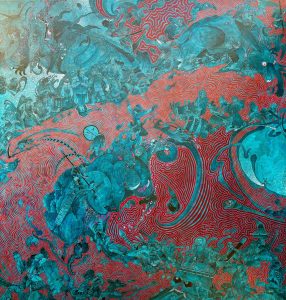 Gerelkhuu Ganbold. Interference (detail). 2020. Acrylic on canvas. 150 x 640 cm. THE gallery. |
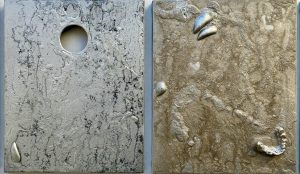 Jon Cuyson. Sea of Echoes Series. 2026. Acrylic, pigments, sand, resin on canvas. 33,5 x 40,5 cm each. Tala Gallery. |
Jon Cuyson (born in Manila), exhibiting at the Tala Gallery booth, unveils a new body of work created exclusively for the 12th edition of Asia NOW. These new creations continue his exploration of themes of memory, identity, migration, and the historical layers that connect the Philippines to the rest of the world. Jon Cuyson is a Filipino artist and filmmaker whose interdisciplinary practice encompasses painting, sculpture, installation, artist's books, and moving images. His work explores maritime histories, labor, migration, queer ecologies, and memory through immersive environments where abstraction, materiality, and narrative converge.
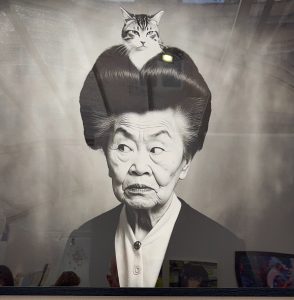 Shavonne Wong. Niceaunties – Auntie Amelia. 2025. AI-generated photography. Chromatic print. 50x50cm. Gallery By Grida. |
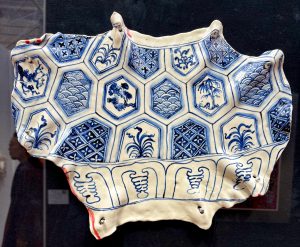 Nguyên Duy Manh. Wandering Souls – The Jar. 2020. Hand-painted ceramic fired in Bat Trang village. 34 x 44 x 3 cm. Bao Gallery. |
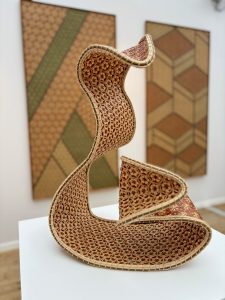 Qian Lihuai. We 11 (2025) in front of The Sky 4 and The Gift 21. Woven bamboo 30 x 30 x 43 cm. Loy Gallery. |
Presented by By Grida gallery, Shavonne Wong (born in 1990 in Singapore) creates hyperrealistic 3D characters to explore themes of beauty, identity, and emotional presence. Her digitally created characters have a human appearance but lack a physical past; they thus question the boundary between human identity and virtual existence.Auntieverse, a universe generated by artificial intelligence by the collective Niceaunties, The familiar figure of the "aunt" becomes a prism for exploring aging, caregiving, family, community, and cultural memory. It's worth noting that humor and tenderness permeate her digital creations.
Our guided tour finished, we had the opportunity to explore all the galleries.
Enhanced by the setting of the Monnaie de Paris in which it took place, our journey allowed us to observe Asia Now's openness to other cultures extending from Central Asia to the Pacific, passing through South Asia and West Asia.
He also challenged us on the role assigned to it by its twelfth edition, namely "a space for encounters and a kaleidoscope of visual shocks"